Choosing the right hose material can prevent leaks, premature failures, and expensive equipment downtime. In 2026, EPDM and silicone remain common choices for automotive, industrial, food, and fluid-handling systems. Their similar appearance often causes confusion. They are not interchangeable.
What is the difference between EPDM and Silicone hoses? EPDM, or ethylene propylene diene monomer, generally performs well with hot water, steam, weather, ozone, and many diluted chemicals. It is often selected for cooling systems and outdoor applications. Silicone hoses offer excellent temperature flexibility, smooth internal surfaces, and strong resistance to aging. They are widely used in engine bays, laboratories, medical equipment, and some food-processing environments. However, silicone usually performs poorly with petroleum-based oils and fuels. EPDM also has important limits.
Material selection requires more than comparing temperature ratings. A hose may face pressure pulses, vibration, abrasion, cleaning chemicals, and repeated bending. I have seen installations fail because engineers checked temperature but ignored fluid compatibility. That mistake is easy to repeat. Manufacturer datasheets, product certifications, and tested operating conditions should guide the final decision. Standards and application requirements also matter, especially where hygienic or safety controls apply. Silicone may feel softer and more flexible by hand, but that does not prove it is stronger. EPDM may appear less specialized, yet it can be the more reliable option in wet, outdoor environments. This guide compares their properties, costs, service conditions, and practical limitations, while recognizing that real performance depends on hose design and installation quality.
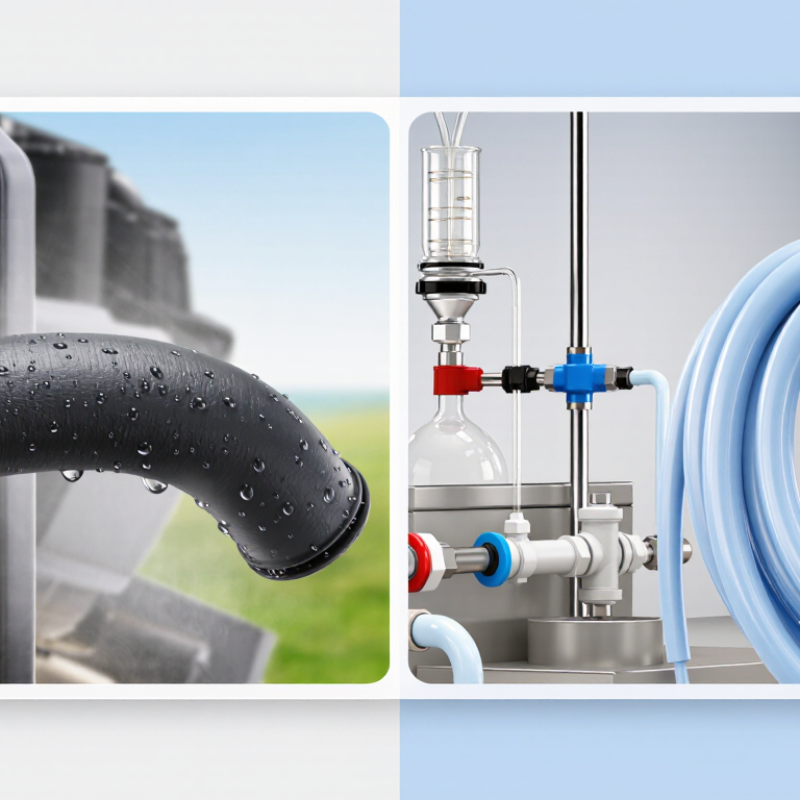
Material Chemistry: EPDM Terpolymer vs Silicone Si–O Backbone
EPDM and silicone hoses can look similar, but their molecular structures create different working behaviors. EPDM is a terpolymer made from ethylene, propylene, and a small diene component. During curing, the diene provides sites for crosslinking. Its finished carbon-based backbone resists water, glycol mixtures, ozone, and outdoor aging.
Silicone uses a different architecture. Its backbone contains alternating silicon and oxygen atoms, written as Si–O–Si. Methyl groups attached to silicon help the hose remain flexible across wide temperature changes. This structure also supports strong resistance to sunlight, ozone, and many environmental conditions. Silicone is not automatically better. It often performs poorly with fuels, many oils, and some solvents.
The practical difference becomes visible during selection. EPDM usually suits coolant circuits, outdoor lines, and hot-water service. Silicone can be valuable where temperature cycling and cleanliness matter. Check the actual fluid.
Pressure matters too.
A hose engineer should review temperature peaks, vacuum exposure, bend radius, reinforcement, and clamp loading. I have seen material comparisons fail because the fluid was tested alone, without considering pressure and aging together. Chemistry guides the decision, but it does not replace application testing. Even a technically suitable compound may fail after repeated flexing or an incorrectly tightened clamp.
2026 Top EPDM vs Silicone Hoses: What Is the Difference?
Material Chemistry: EPDM Terpolymer vs Silicone Si–O Backbone
EPDM terpolymer
An ethylene–propylene–diene rubber with strong resistance to weathering, ozone, water, steam, and many dilute acids and alkalis. Typical continuous service temperatures are approximately −50°C to +150°C.
Silicone rubber
A polymer built around a flexible silicon–oxygen backbone. It offers a wider temperature window, commonly about −60°C to +200°C, but generally has lower tensile strength and weaker resistance to abrasion and many fuels or oils.
Values shown are representative typical material limits; actual hose performance depends on compound formulation, reinforcement, pressure, fluid, and operating conditions.
Chemical Resistance: EPDM Handles Ozone; Silicone Resists Heat but Not Oils
EPDM and silicone hoses differ most clearly under chemical exposure.
EPDM handles ozone exceptionally well because its saturated backbone resists cracking in outdoor air. ISO 1431-1 ozone testing commonly uses controlled exposure near 50 pphm at 40°C. Fine surface cracks can still appear when stretching, cutting, or clamping the hose.
Silicone performs better at elevated temperatures.
Many technical data sheets place silicone service near 180–200°C, while EPDM often operates around 150°C, depending on formulation. Heat is not the whole story. ASTM D471 and ISO 1817 evaluate rubber volume, hardness, and tensile changes after liquid immersion. These tests show why silicone may swell or soften in petroleum oils, fuels, and some lubricants. It is a heat specialist, not an oil specialist.
EPDM also dislikes petroleum oils.
That detail is often missed. For outdoor coolant, water, steam, or ozone exposure, EPDM is usually the safer engineering choice. For high-temperature air, dry heat, or flexible laboratory connections, silicone can be more suitable. Check the actual chemical, concentration, pressure, and temperature together. A hose that survives 200°C briefly may fail after weeks of oil contact. The imperfect part is prediction: compound recipes vary, and generic charts cannot replace immersion testing. A small sample test may prevent a large failure.
Mechanical Data: Tensile Strength 7–14 vs 5–10 MPa; Shore A 50–80
2026 Top EPDM vs Silicone Hoses: What Is the Difference?
Mechanical data often separates EPDM and silicone hose selection. Published test reports using ASTM D412 and ISO 37 commonly place EPDM tensile strength around 7–14 MPa, compared with 5–10 MPa for silicone. This difference means EPDM may resist pulling and stretching more effectively under ordinary service conditions. Shore A hardness also matters. Typical values range from 50–80, depending on the compound, curing system, and reinforcement.
A harder hose can feel more stable during clamping, but hardness alone does not predict service life. An EPDM hose at Shore A 70 may resist deformation better than a softer grade. Silicone at Shore A 50 can remain more flexible around tight bends. It may also handle temperature cycling well, while EPDM generally offers strong resistance to weathering, water, and many diluted chemicals.
Test conditions change the result. ASTM D412 reports tensile strength at a controlled pulling speed and specified specimen shape. Real hose performance includes pressure, vibration, heat, and repeated bending. That is where a clean comparison becomes imperfect. A higher MPa value does not automatically mean better sealing.
For practical selection, compare tensile strength with Shore A, wall thickness, burst pressure, and working temperature. Check the actual laboratory report, not only a catalog range. Small formulation changes can move the result noticeably. A hose that looks stronger on paper may still fail at a sharp clamp edge.
2026 Top EPDM vs Silicone Hoses: What Is the Difference? — Mechanical Data: Tensile Strength 7–14 vs 5–10 MPa; Shore A 50–80
| Comparison Dimension |
EPDM Hose |
Silicone Hose |
Practical Interpretation |
| Typical tensile strength |
7–14 MPa |
5–10 MPa |
EPDM generally provides higher resistance to pulling and tearing in comparable non-reinforced compounds. |
| Typical hardness |
Shore A 50–80 |
Shore A 50–80 |
Both materials can be formulated across similar hardness ranges; hose design and reinforcement also affect flexibility. |
| Typical service temperature |
Approximately −50 to +150 °C |
Approximately −60 to +200 °C |
Silicone usually offers a wider high-temperature operating range; actual limits depend on compound, pressure, and exposure time. |
| Low-temperature flexibility |
Very good |
Excellent |
Silicone generally remains more flexible at very low temperatures, while EPDM also performs well in cold environments. |
| Resistance to ozone, weather, and UV |
Excellent |
Excellent |
Both are suitable for outdoor exposure and resist cracking caused by ozone and sunlight better than many general-purpose rubbers. |
| Hot water and glycol coolants |
Excellent to very good |
Good, depending on formulation |
EPDM is commonly selected for water, radiator, and glycol-coolant service; compatibility should still be verified for additives and temperature. |
| Mineral oils and hydrocarbon fuels |
Poor |
Poor to limited |
Neither material is a general first choice for petroleum oils or fuels; oil-resistant elastomers may be more appropriate. |
| Dilute acids and alkalis |
Very good |
Good for selected chemicals |
EPDM is often preferred for many aqueous chemical services, but concentration, temperature, and exposure time must be checked. |
| Gas permeability |
Lower than silicone |
Relatively high |
EPDM is generally better where limiting air or gas permeation is important; silicone may require a barrier layer. |
| Flexibility and handling |
Good |
Very good |
Silicone is often easier to route and bend, although reinforcement, wall thickness, and hardness strongly influence flexibility. |
| Abrasion and tear resistance |
Generally good |
Generally lower than EPDM |
EPDM is usually more suitable for rubbing, dragging, and mechanically demanding service. |
| Compression set behavior |
Low to moderate, compound-dependent |
Moderate to high, compound-dependent |
EPDM may retain sealing force better in some static sealing applications, while temperature and cure system are important variables. |
| Common application areas |
Cooling systems, water lines, outdoor equipment, HVAC, and non-oil chemical service |
High-temperature air, cooling systems, laboratory equipment, appliances, and flexible tubing |
The correct choice depends on fluid compatibility, temperature, pressure, flexibility, permeation, and regulatory requirements. |
| Relative cost tendency |
Usually lower |
Usually higher |
EPDM is often the more economical option for water and outdoor applications, while silicone costs more when its temperature or flexibility advantages are required. |
Note: Values are typical comparative ranges for general hose compounds and are not design limits. Actual performance varies with formulation, reinforcement, wall thickness, pressure, fluid concentration, temperature, and applicable standards.
Standards and Selection: SAE J20, FDA 21 CFR, and Application Fit
2026 Top EPDM vs Silicone Hoses: What Is the Difference?
Standards and Selection: SAE J20, FDA 21 CFR, and Application Fit
Choosing EPDM or silicone starts with the fluid, temperature, pressure, and installation environment. SAE J20 is commonly used for automotive coolant and heater hose requirements. It addresses dimensions, performance, resistance, and test methods. However, SAE J20 compliance does not automatically prove suitability for every coolant, fuel, or chemical.
EPDM usually performs well with water, glycol-based coolants, ozone, and outdoor exposure. It is often practical for radiator circuits and general cooling systems. Silicone handles wider temperature ranges and remains flexible near hot engine components. It can be a poor choice where abrasion, sharp edges, or certain oils are present. Check the actual compound, not only the word “silicone.”
For food, beverage, or pharmaceutical contact, FDA 21 CFR references may become important. The exact applicable section, formulation, temperature, cleaning chemical, and contact time must match the application. A hose described as “FDA compliant” still needs traceable documentation and suitable fittings. It should also resist repeated washdown without swelling, cracking, or shedding particles.
I have seen selection errors caused by focusing on temperature alone. A hose may survive a hot cycle but fail under movement, vacuum, or tight bending. Measure the bend radius and inspect nearby clamps. Then confirm pressure ratings at operating temperature, because they can change significantly. The neatest specification is not always the safest one.
Conclusion
What is the difference between EPDM and Silicone hoses? The main distinctions involve their chemistry, temperature performance, chemical resistance, and application suitability. EPDM is an ethylene-propylene-diene terpolymer with strong resistance to ozone, weathering, water, and many chemicals. It typically operates from approximately −40°C to 150°C. Silicone, built around a flexible Si–O backbone, provides a wider temperature range of about −60°C to 200°C and maintains flexibility in demanding heat or cold. However, silicone generally performs poorly when exposed to oils and petroleum-based fluids.
Mechanical properties also influence selection. EPDM commonly offers tensile strength of about 7–14 MPa, while silicone is usually around 5–10 MPa. Both materials are available in different Shore A hardness levels, typically from 50 to 80. When choosing a hose, consider fluid compatibility, operating temperature, flexibility, pressure, and service environment. Relevant requirements may include SAE J20 for automotive coolant applications and FDA 21 CFR for suitable food-contact uses.
 Marketo Auto
